


Avoid losing a harvest
Wireless CO2 Sensor

Rely on agrilog CO2 Sensors
For early detection of grain storage problems, secure your bin or warehouse with agrilog wireless CO2 grain monitoring sensors. Quickly identify critical warning signs of grain soilage like water infiltration, mold development or grain heating before your losses become irreversible.
In addition to CO2, our sensors monitor temperature and humidity, providing essential data to protect your harvest throughout your entire storage.
The benefits of agrilog Wireless CO2 Sensors:
-
Early detection of soilage : heated grain, mold and insects.
-
4x faster than cabled sensors
-
20x more surface area covered than cabled sensors
-
Automatic SMS alerts when an anomaly is detected
-
Wireless and portable, easy setup and mobility
Common storage problems
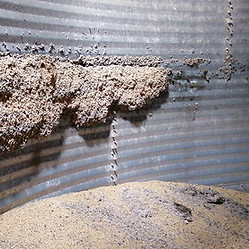
Grains sticking to the walls
Mold problems on the walls often appear in soybean bins. Grain that is slightly too moist, combined with cold autumn days and a lack of ventilation at harvest, are all causes that favor condensation on the walls.
Heated grain and bin core
Even after drying, grain stored in a bin remains at risk of heating up. Broken grain accumulated in the center of the bin, compacted during filling, complicates ventilation. When temperatures are warm (20°C) at harvest, grain leaving the dryer can reach 25-28°C. At this temperature, the grain can continue to transpire, which can quickly cause thermal runaway and overheating of your grain.


Rooftop condensation
As your grain cools, the warm, moisture-laden air leaving the grain mass can condense on the roof of your bin, even at 10°C! This condensation can create water droplets. Over time, if these droplets fall on your grain, the top layer of grain will harden and form a crust.
How does it work?

Your bin breathes!
Have you ever seen a hot-air balloon take off? As you know, hot air rises and cold air drops. The same phenomenon that enables hot-air balloons to take flight also occurs in your grain bin. The mass of grain influences the air temperature and creates air circulation in your bin.
During the day, convection forces the air to escape through the top of your bin. Thanks to this principle, our wireless (no-cable) grain CO2 monitoring sensors are able to monitor air quality. If the concentration of CO2 rises in your grain bin, there's a storage problem!
The solution
Why focus on CO2?
All biological activity releases carbon dioxide (CO2). When your grain tries to germinate, it consumes its starch, releasing energy, moisture and CO2. It's the same process when your grain ferments or heats up.
When air circulates in your silo, it transports CO2 to the outside. In this way, the air enables the agrilog sensor to detect any abnormal concentration and take swift action. Acting early protects your income.

Protect your harvest!
Quick and easy to install:
Place the CO2 sensor on an air outlet or on the roof outlet vent of your silo. Thanks to its wireless connectivity, quickly install it on the silo or the warehouse you want to monitor.
Monitor:
Connect to the agrilog platform to follow the evolution of CO2 in your storage silos. When CO2 values tend to increase, it is starting to respond!
Ideal for :
-
Hay storage facilities
-
Grain bins and warehouses
-
Potato and other fruit and vegetable warehouses

